A Lonely Grave by Lebanon Lake
Near Lebanon Lake in Lumberland, a stone wall holds the grave of Nathan Freisleben of Bohemia, who died on 22 December 1851 at age fifty-nine.
The slab inside its stone wall. You can walk around the grave. Click into the walls to see inside the enclosure.
One grave in the woods
Near Lebanon Lake, the trees close around a square stone wall, and inside stands a single marble slab. Its English face names Nathan Freisleben, born in Bohemia, dead on 22 December 1851 at fifty-nine, and beneath his name says the quarter acre around his grave had not been sold and could never be sold: “One-fourth acre of the ground around where his remains lie has not been sold nor shall it be.”
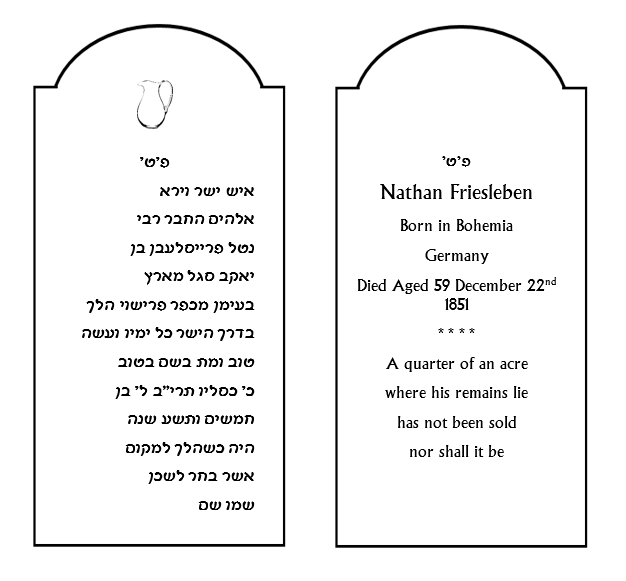
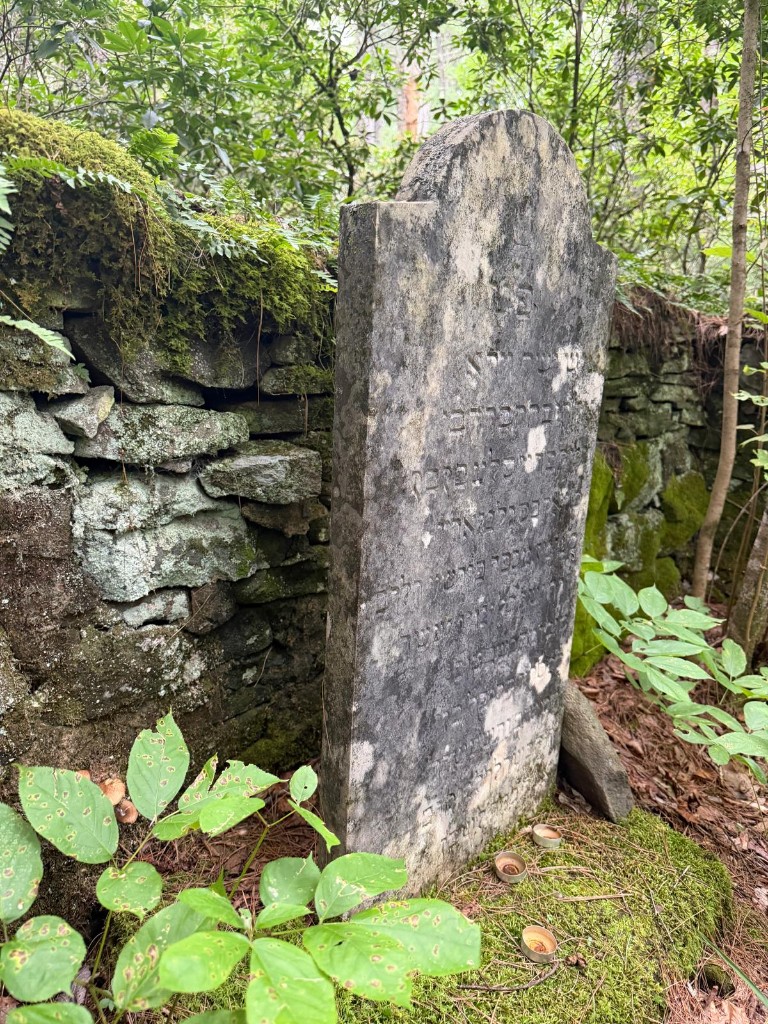
On the other face, the Hebrew calls him a learned man, Rabbi Nutal (Nathan) Freisleben, son of Yaakov Segal, from Purschau in Bohemia. Segal is a traditional name for a Levite family, which is why a pitcher is carved above the words. The two faces agree he died at fifty-nine, then disagree by eight days on the date of death.
The slab keeps Nathan’s name and Purschau. Who chose this place for him, and who built the enclosure and set aside the quarter acre?
What George West remembered
Forty-three years after Nathan’s death, George West of Lumberland still remembered the Jewish families in the hills, and as a boy he had watched their shechitah. In the summer of 1894, Monticello’s weekly newspaper, the Republican Watchman, printed those memories and identified the man inside the wall as Nathan “Frisleben,” one of the area’s early Jewish settlers.
West remembered a wife buried beside Nathan and a wealthy son in the western United States who had ordered the wall built, a description that points toward a merchant from Purschau who had made his fortune in California.
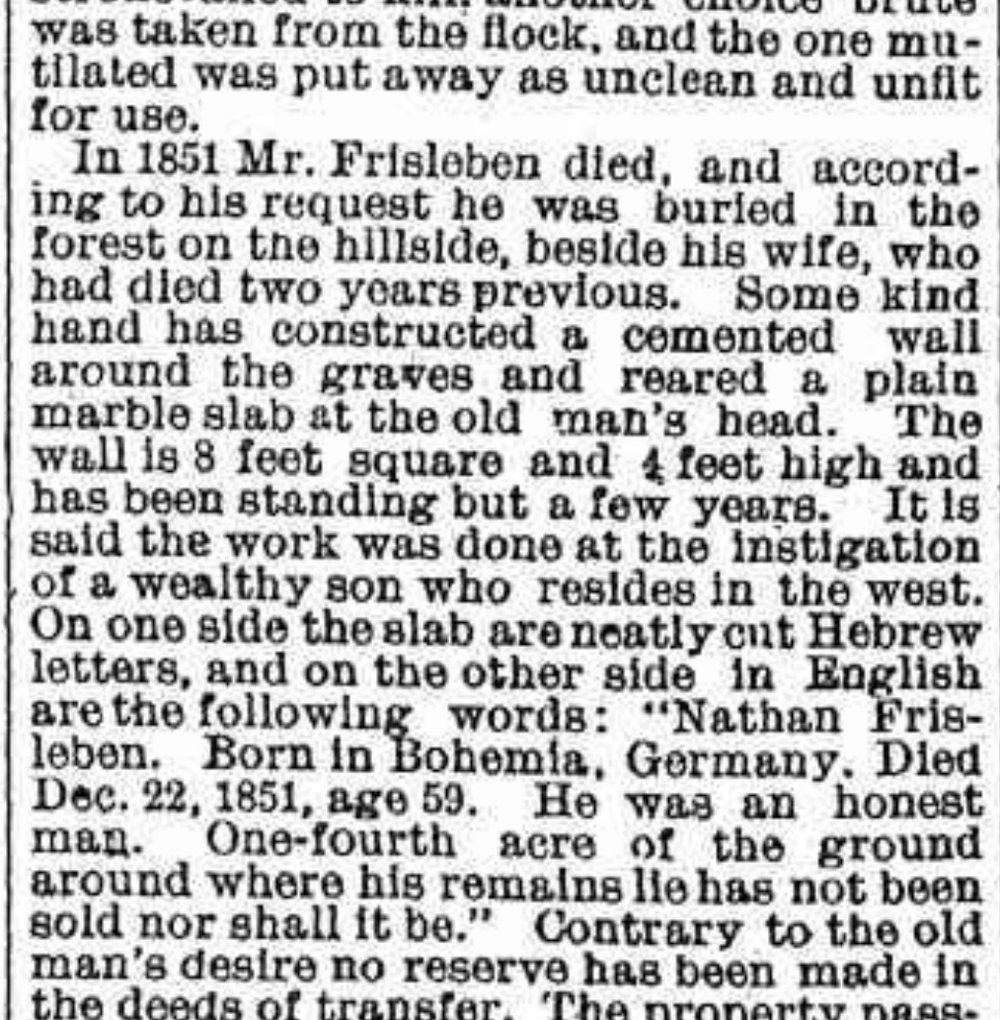
Nine years later the Hancock Herald, a newspaper in Hancock, New York, ran an item headed “A Lonely Grave” that asked about the “silent tenant” behind the wall. An answer followed in the same paper under the altered surname Fiesland, and that answer carried a child into the story.
“Sixty-one years ago, in the year 1842, a Jewish family of the name of Fiesland settled in that locality, which was then a wilderness. The family consisted of a rabbi of the Jewish synagogue, well advanced in years, his four sons and their wives and children. One day a granddaughter of the patriarch strayed off into the surrounding woods and was lost and five months elapsed before her dead body was discovered in a desolate spot about a mile from her home. The child was buried, and about the grave was built a solid wall of stone masonry sixteen feet square. In 1852 the aged rabbi died and was buried within the stone enclosure, as our informant thinks, in the same grave with his little granddaughter.”
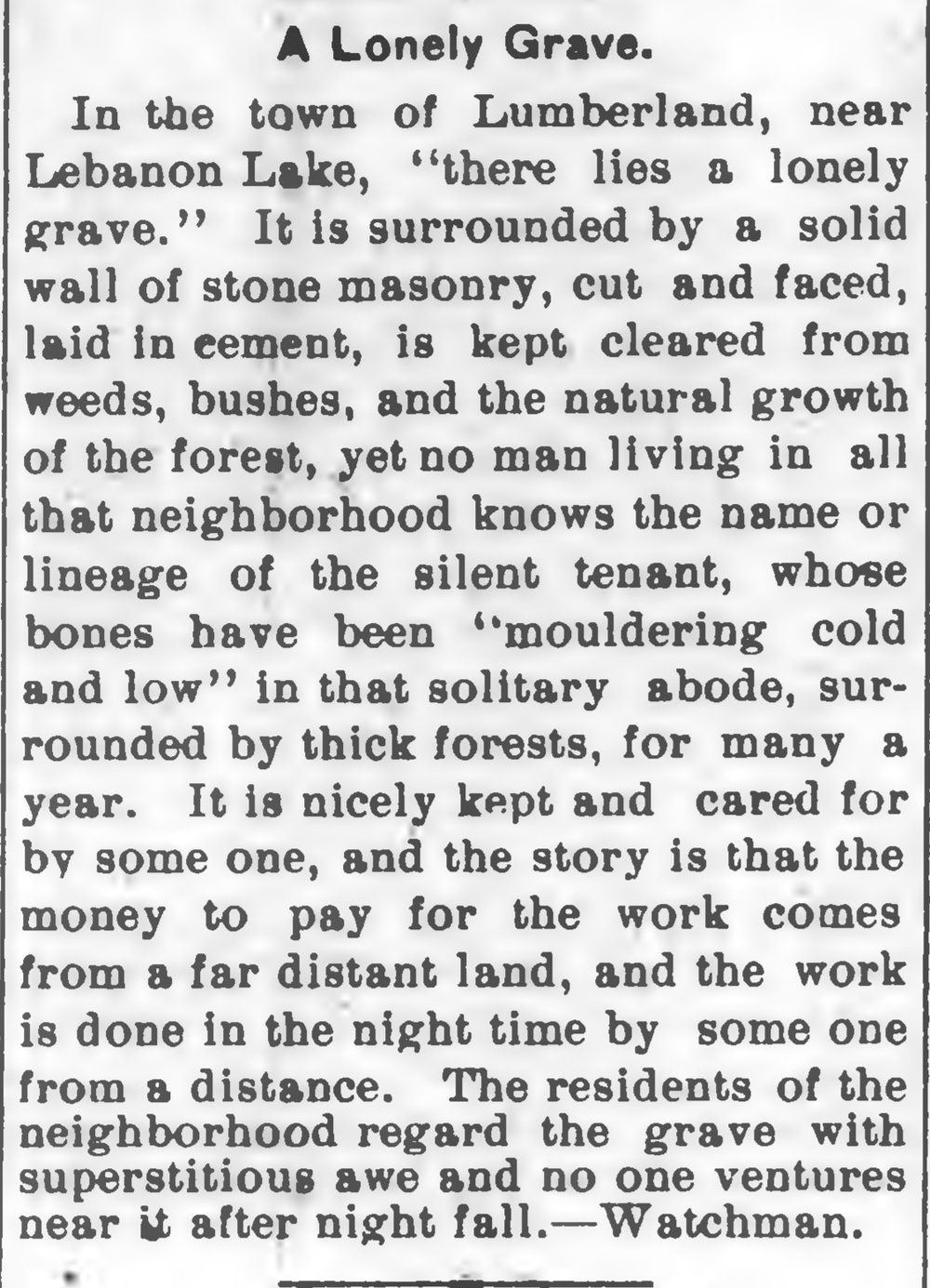
Whether Nathan was buried with a grandchild, with his wife, or alone is still the question, so the family trail starts in Purschau.
The family in Purschau
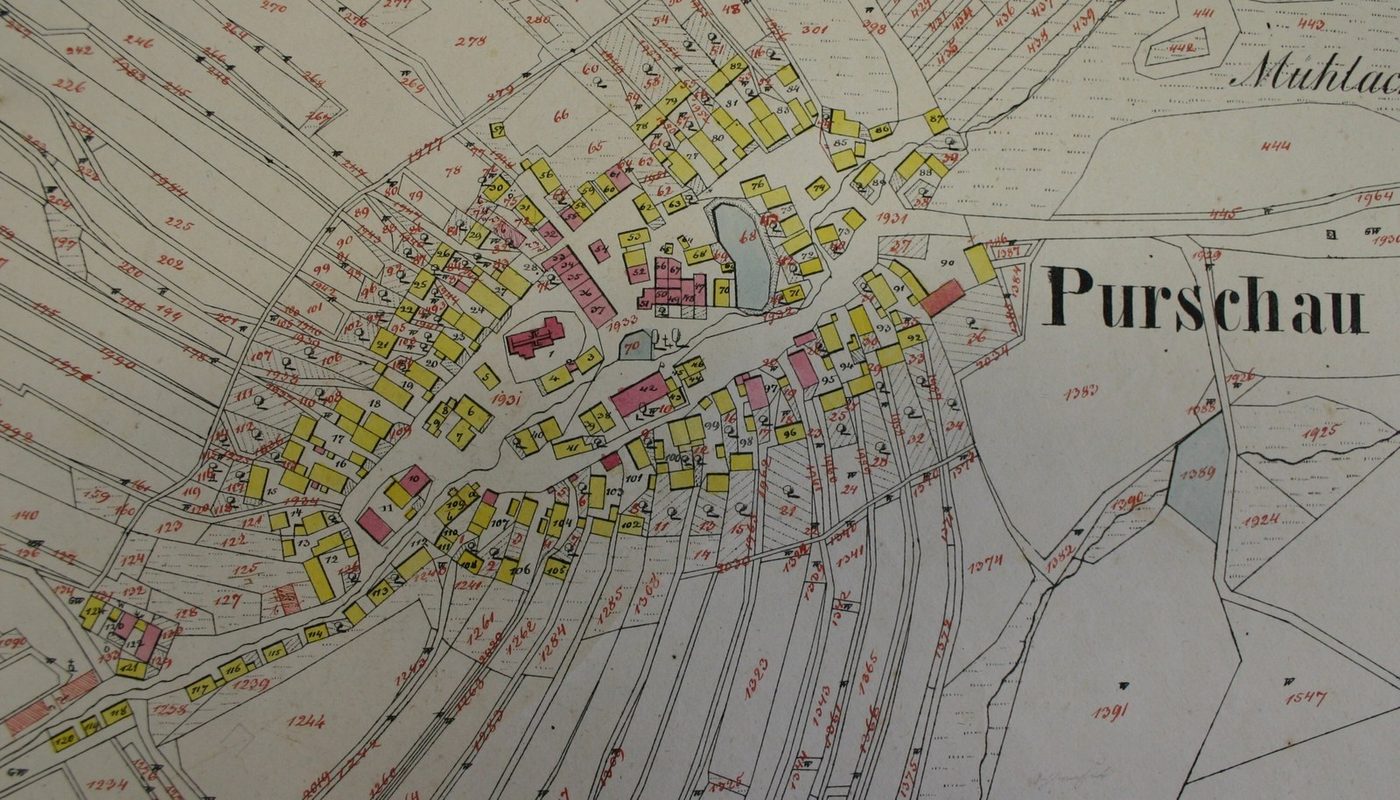
Purschau, now Pořejov, lay in western Bohemia, and at its center stood house no. 1. That number was the building’s official address: the old manor, with a shul dating to 1765 in one wing. In 1838 the village had 734 people and 104 houses, yet all fourteen Jewish families shared just four of those houses. The Jewish cemetery held roughly 300 gravestones, many of them Levites, which ties the pitcher on Nathan’s grave to the village he came from.
The family first appears nearby in 1783, when Jacob Nathan lived in Tachau with his wife and two children, earning his living from ribbons or bands and knives. By 1793 the records call him Jacob Freyßleben and place him in Purschau with his wife Sara and two daughters. A clerk shortened or rendered the daughters’ names as “Ja” and “Rößl,” spellings whose full forms are uncertain. One register gives Sara’s birth name as Bloch and her birthplace as Floss in the Palatinate, today Floß in Bavaria.
By 1811 the family was already tied to house no. 1, the old manor with the village shul: a property entry that year records a capital obligation of 200 gulden in favor of Jakob Freisleben. Under Bohemian law, Jewish families needed one of a limited number of government permits to marry and establish a household, and on 24 July 1819 Jakob transferred that permit to his eldest son Nathan, recorded in Purschau’s familiant book (the official Jewish household register). The same record associates Jakob Freyßleben with the earlier name Jakob Nathan. A published Pilsen control list cites the government decree behind the transfer: no. 33038, dated 24 July 1819.
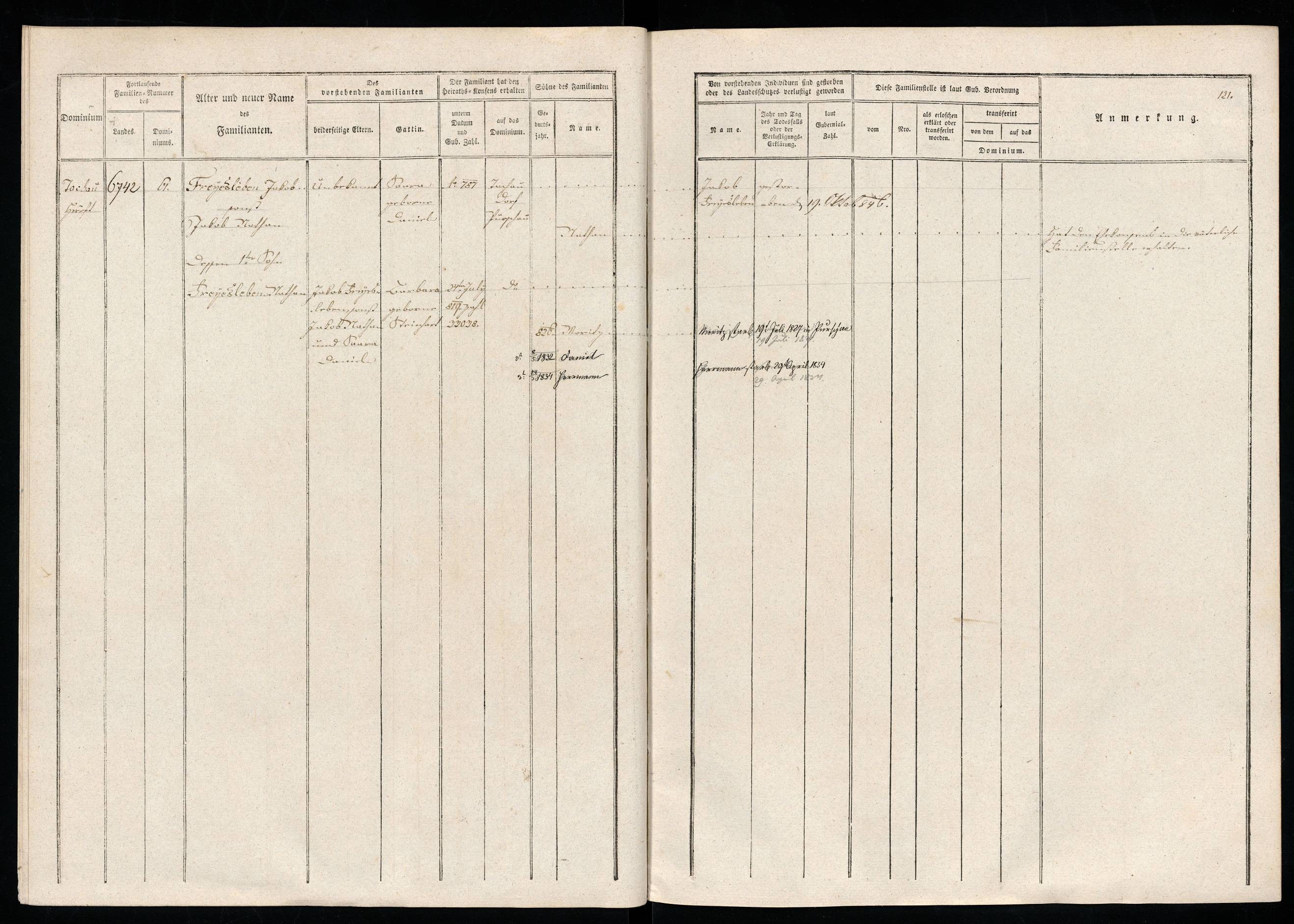
On 25 February 1822, Juda Jacob Freisleben senior executed a contract selling Purschau property no. 8 to Nathan Freisleben junior for 300 gulden; the contract was presented on 19 August 1822 and entered in the Purschau ground book on folio 72. Nathan now held the family permit and the house next door, while Jakob stayed at house no. 1, the old manor with the shul, the address already tied to him in the 1811 land-book entry.
On 8 May 1832 the next generation appears at house no. 8: a birth entry names Daniel, son of Nathan and Barbara, and identifies Nathan as Jakob’s son. An August 1834 birth in the same register still names Nathan, son of Jakob, as the child’s father, and that is the last secure record of Nathan acting as a father in Purschau.

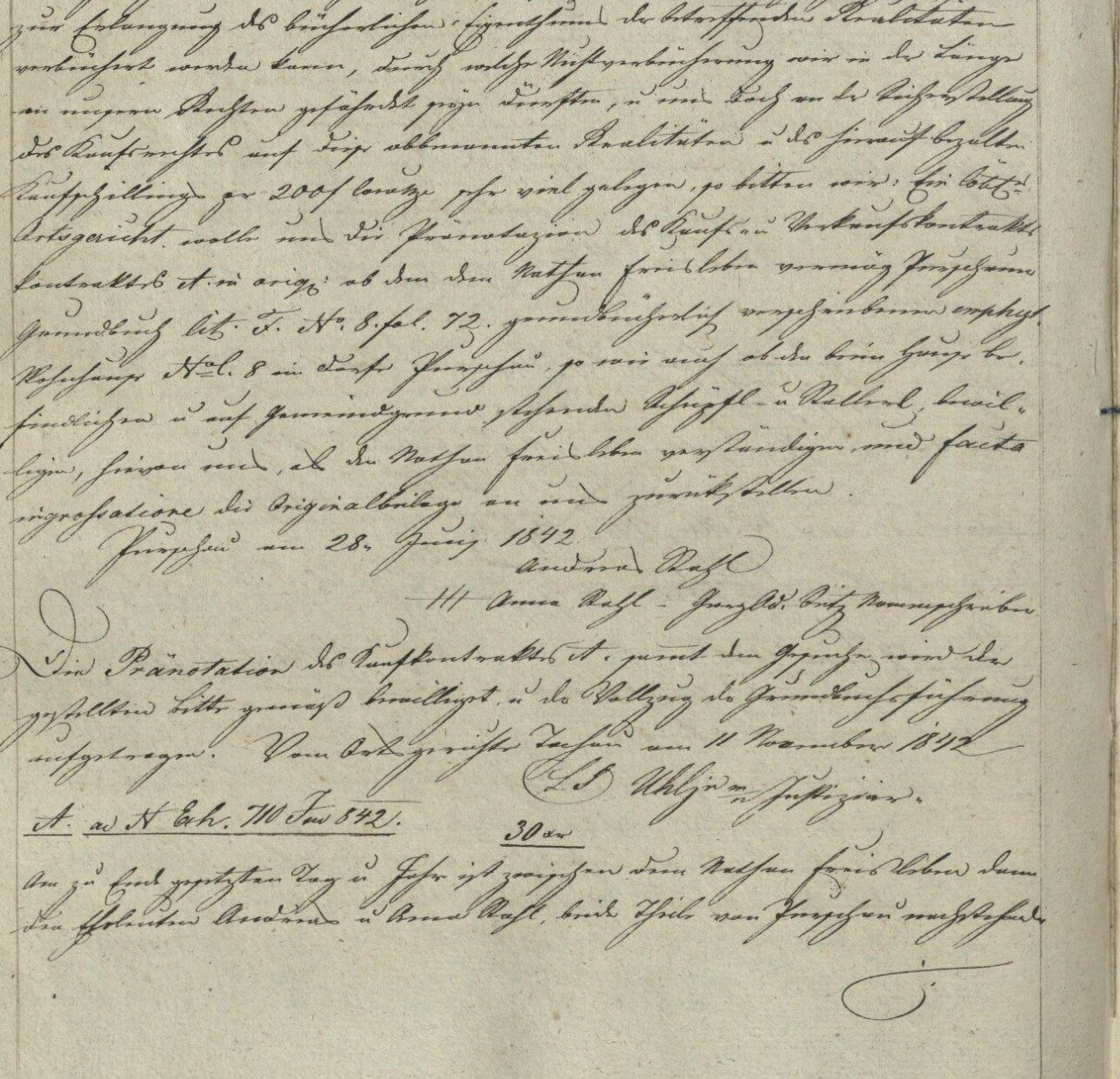
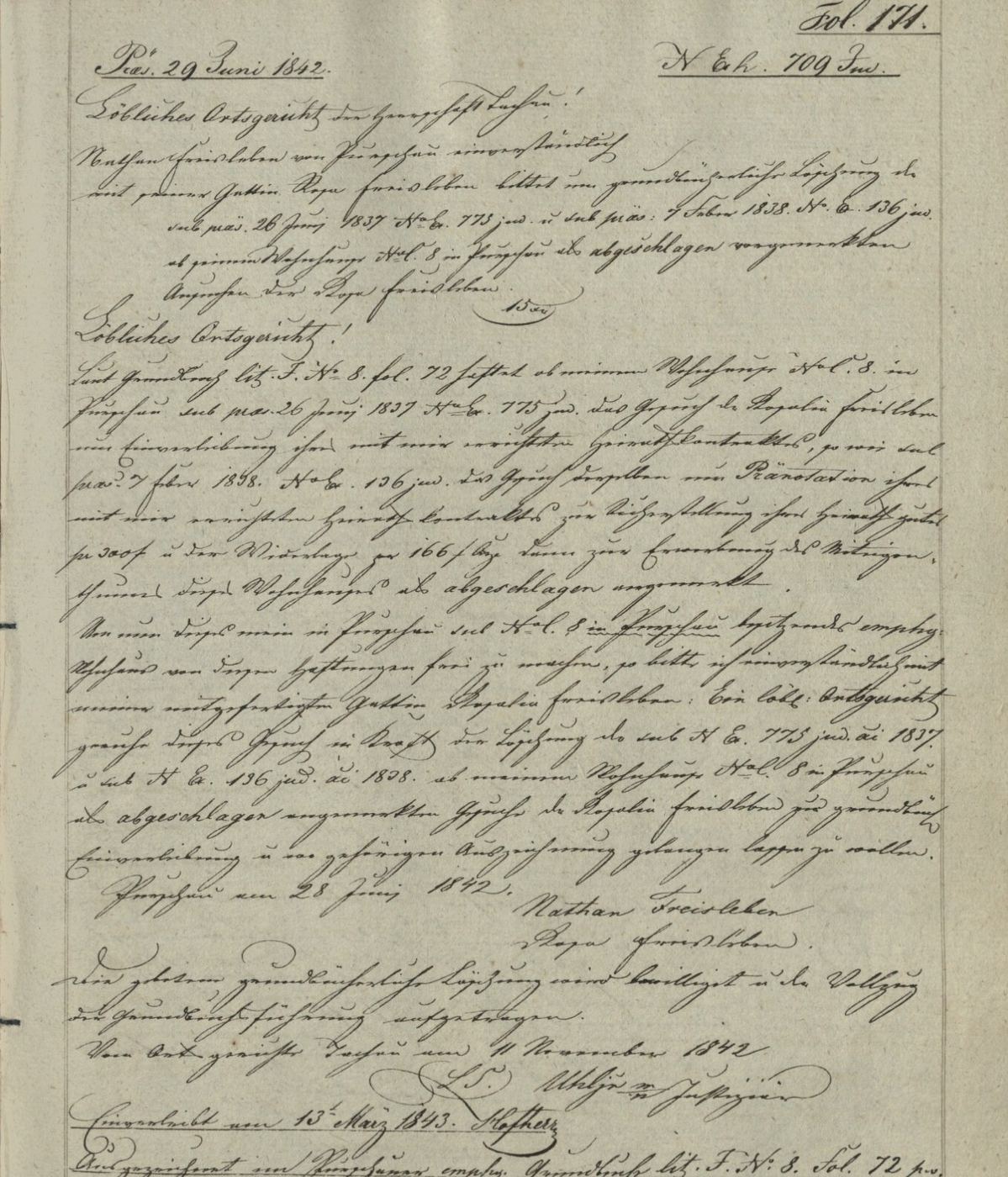
Then, on 28, 29 June 1842, Nathan sold the emphyteutic dwelling at Purschau conscription no. 8 to Andreas and Anna Stahl for 200 gulden Convention currency. The title clause expressly connects Nathan’s ownership to the Purschau ground book, lit. F, no. 8, folio 72, the folio of the 1822 father-to-son deed. Andreas signed his name; Anna, who apparently could not sign, made three crosses, a standard legal substitute for a written signature. A related filing identifies Rosa, also written Rosalia, as Nathan’s wife and preserves her signature. The 1832 birth entry had called Daniel’s mother Barbara, and the records examined so far do not show whether Barbara and Rosa were the same woman under different names, or whether one clerk made an error.
The sale paper does not say where they were going. That July another Freisleben, Leopold, reached New York aboard the Stephanie. By December we know Rosa had already left: a Tachau court notice in Prague’s official gazette, the Amtsblatt zur Prager Zeitung, listed her whereabouts as unknown. The same notice named her among the heirs of Barbara Steinhart of Uschau (Úšava), a village in the same district as Purschau, who had died the year before at house no. 34. The notice does not say how she was related to Barbara, but we know Barbara was her mother, so once Rosa was gone she was still named in an inheritance back home.
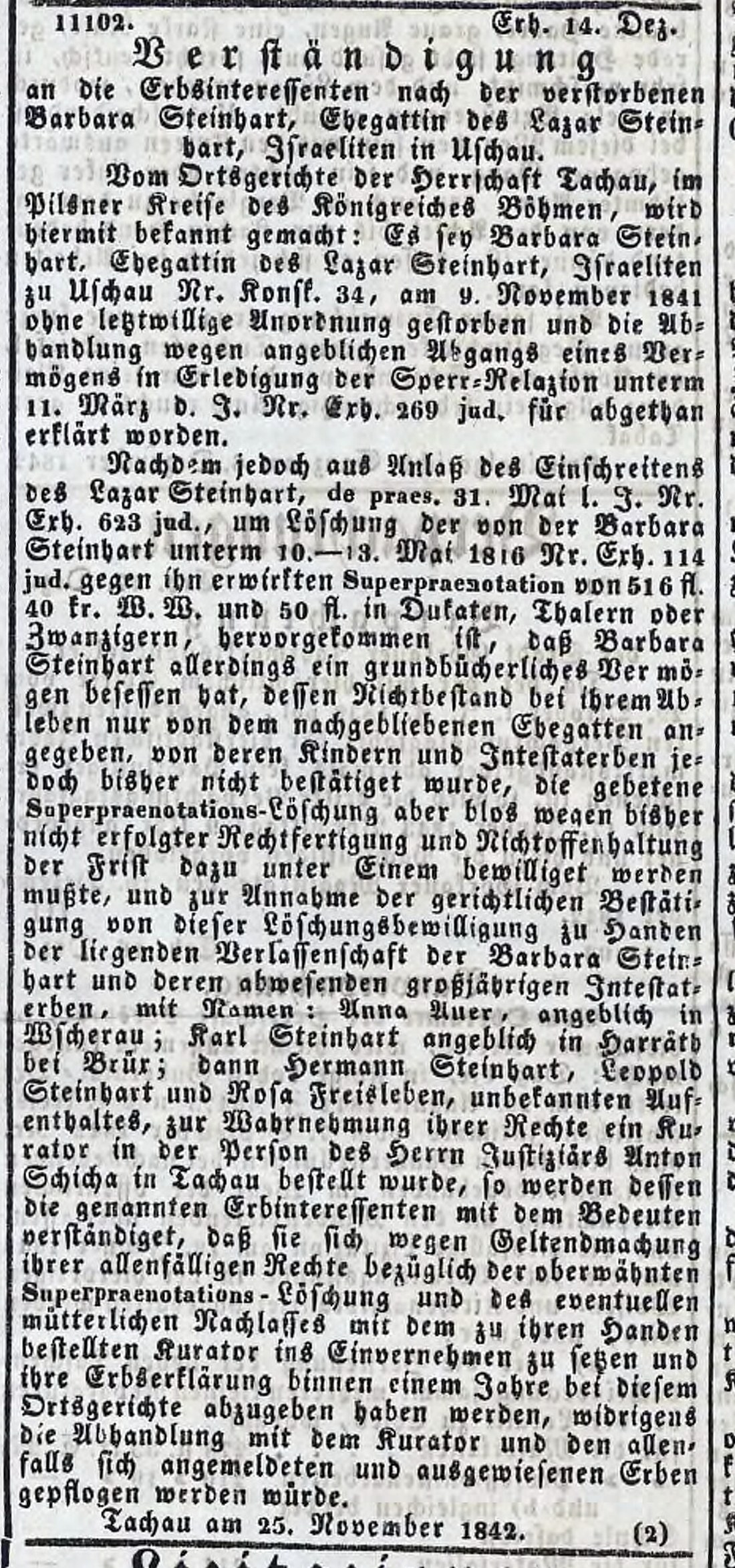
A child in the snow
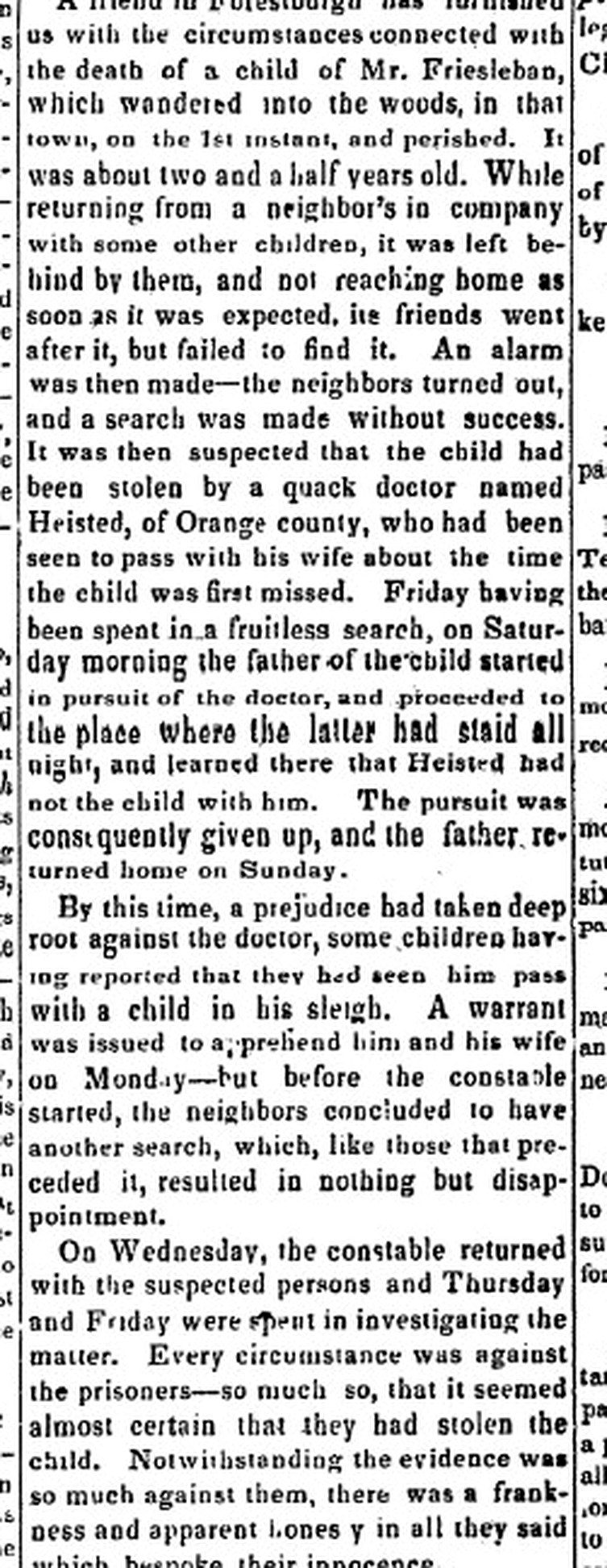
Two years after the sale of house no. 8, a Freisleben child set out from a neighbor’s home near Lumberland. The other children walked ahead, and when they reached home without the child, a search began.
For ten winter days the child was missing, until searchers found the body face-down in the snow beside a little-used path. Monticello’s Republican Watchman reported the death in March 1844 under the name “Mr. Friesleban,” and placed the search in the woods of neighboring Forestburgh.
That 1844 report shows where the lost-child story published in 1903 began. It does not identify the child as Nathan’s granddaughter or say where the child was buried, and it concerns a child, not the wife whom George West remembered as buried beside Nathan.
Jakob’s last years in Purschau
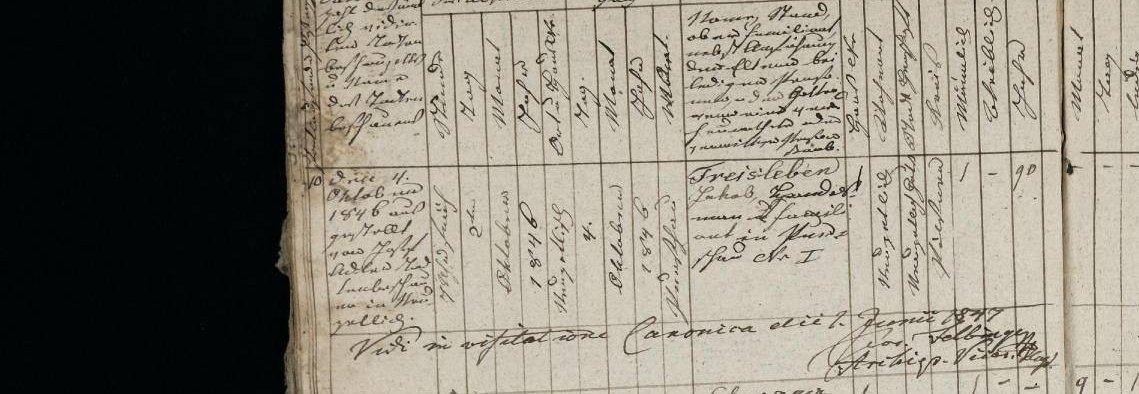
While Nathan’s household prepared to leave, Jakob still lived in house no. 1, the family’s older address in the manor wing with the shul, and the death register would still place him there. On 9 July 1843 he executed a contract selling property to David Schwager; a later registration dated 13 March 1850 describes that property as half of the emphyteutic dwelling at conscription no. 1, the same house. Jakob died in Purschau on 2 October 1846, recorded as a ninety-year-old merchant of house no. 1. Five years later and thousands of miles away, Nathan’s Hebrew epitaph would name his father as Yaakov Segal and his home as Purschau, carrying both father and village into the Lumberland woods.
By Lebanon Lake
Lumberland, Sullivan County, New York
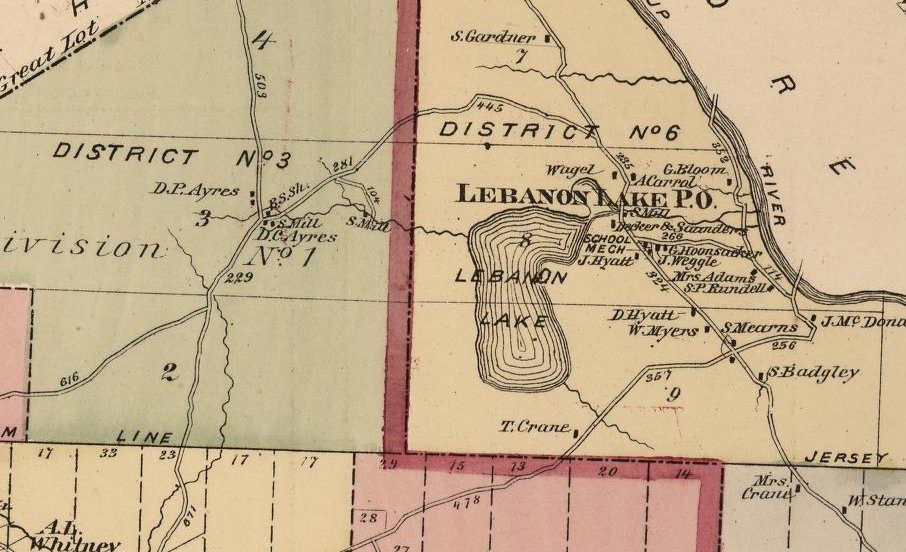
By 1850 several Freisleben households and farms stood in the hills around Lebanon Lake, and the census taker wrote the surname as Frislabend. He listed Nathan as N., a farmer, with R. and an 18-year-old D. in the same household; other records identify R. as Rosa and D. as Daniel. The enumerator wrote Nathan’s age as 75, though the date and age carved on Nathan’s grave show that he was about fifty-eight in 1850. Nearby, Leopold and Sarah were raising their children, including the younger ones born after the family reached New York.
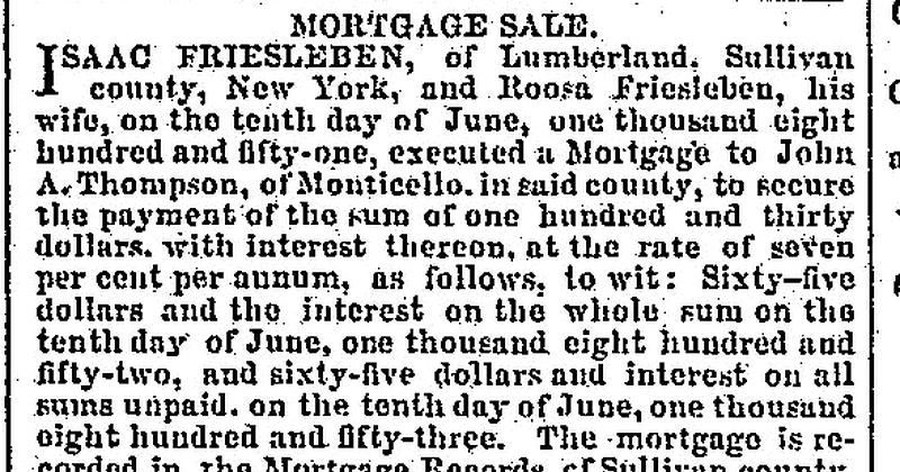
Another Freisleben family was missing from that census sheet. Isaac and Roosa appear in Lumberland records the following year, when they borrowed money against their land at Halfway Brook, and an 1854 notice advertised a sale of the property after the mortgage debt was not paid.
These were the families George West remembered from boyhood, building homes and farms in the wooded hills, and around Lebanon Lake they kept a small kehillah among non-Jewish neighbors, as they had in Purschau.


On 22 December 1851 Nathan died at fifty-nine and was buried near the lake, with the surrounding quarter acre reserved from sale. Decades later George West would credit the wall to a wealthy son living in the West, so the search for that son leads to Daniel Freisleben.
Daniel goes west
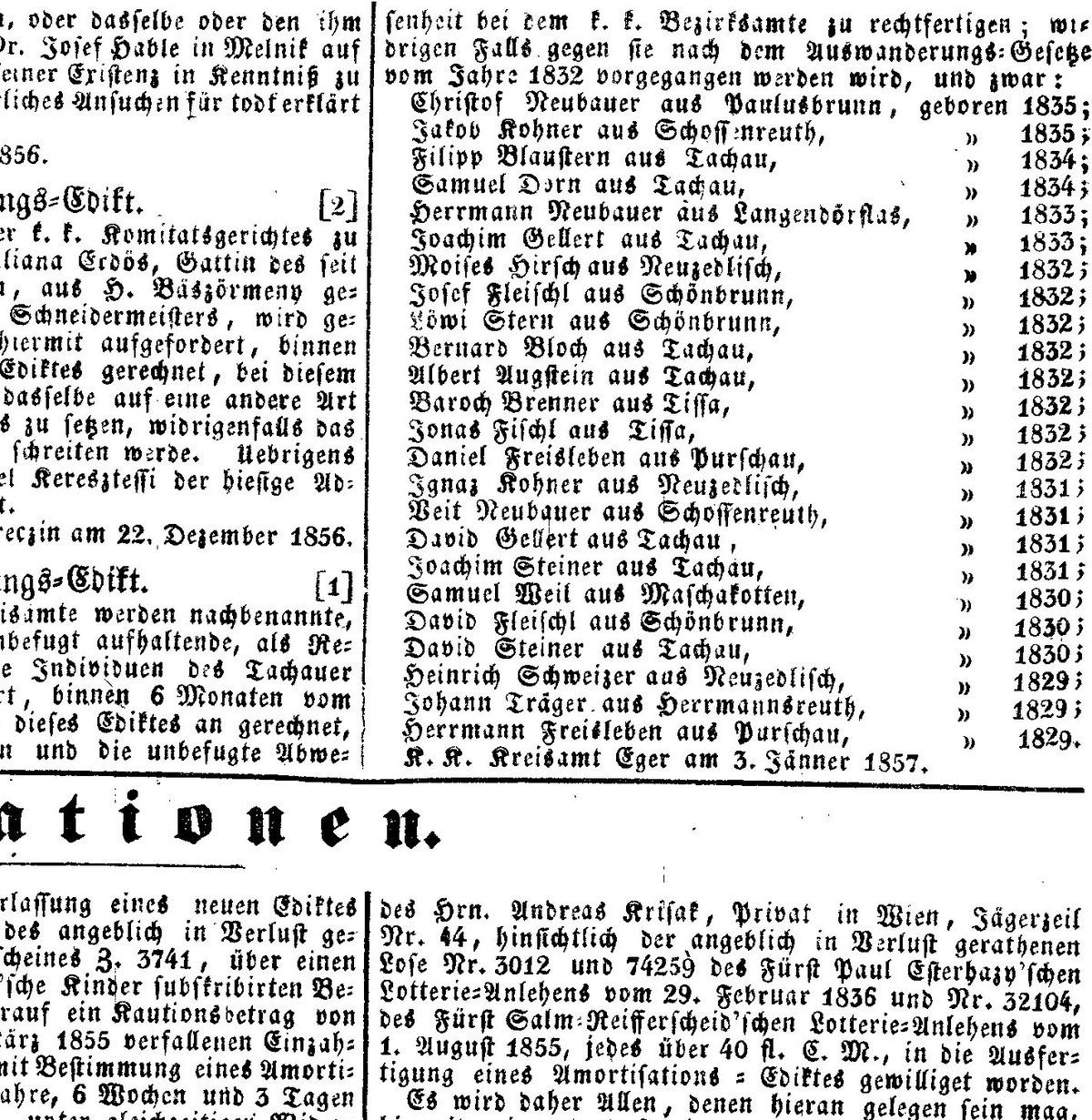
Daniel likely reached America with the Freisleben family around 1842, when he was ten, and the 1850 census places him, as D., age 18, in Nathan and Rosa’s Lumberland household. Austrian officials kept looking for him after he left. An 1853 Tachau-district absentee list already named Daniel Freisleben of Purschau, born 1832, together with Andreas Freisleben of Purschau, born 1829. In 1856 a Tachau recruitment-fugitive declaration named Hermann Freisleben of Purschau and gave his birth year as 1834. Then, in January 1857, an Austrian military edict ordered Daniel and other emigrants living in America to return within six months, and the same edict names Hermann Freisleben of Purschau, born 1829, among the Tachau-district men said to be in America. The notices do not say how Daniel, Andreas, and Hermann were related, or whether the 1856 and 1857 Hermann entries, with conflicting birth years 1834 and 1829, name one man or two. Daniel did not return. He crossed the country and made a new life as a merchant in Oroville, California.
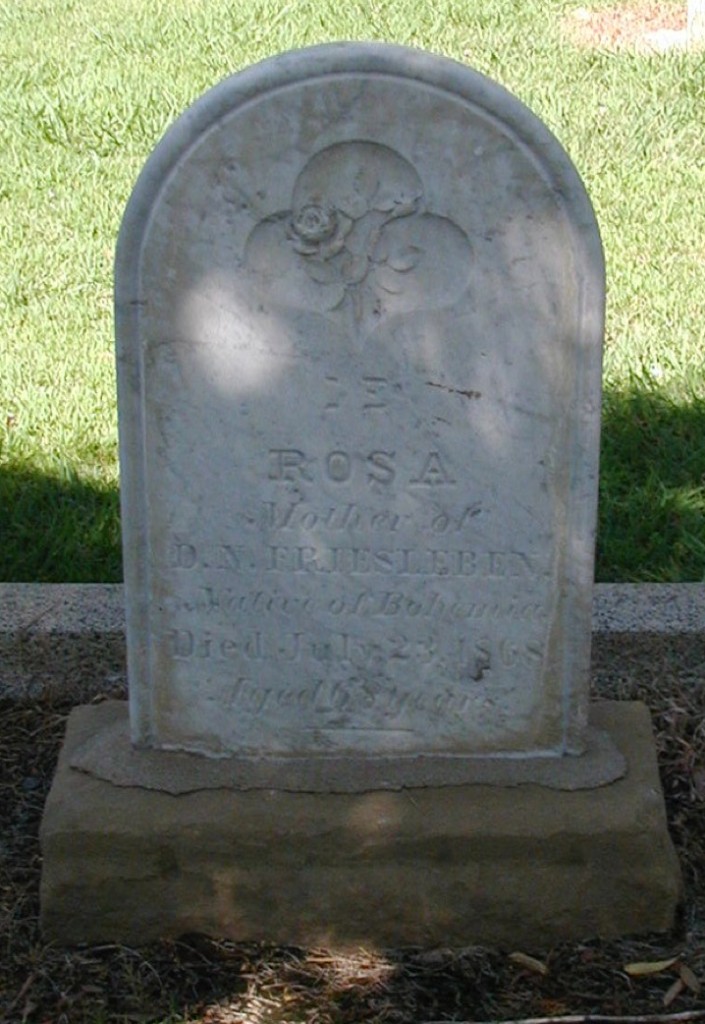
After Nathan’s death, Rosa went west to Oroville. She was buried there in 1868 at sixty-eight, not beside Nathan inside the stone wall as George West later recalled, and her grave named her simply: “Mother of D. N. Freisleben.”
By 1863 a Pacific States business directory listed D. N. Friesleben under dry goods. In 1866 another directory placed that dry-goods and clothing business on Montgomery Street, while listing the Union Hotel separately under W. L. Hopkins. By about 1880 his name hung above the back counter of his store, and an 1881 county directory called him proprietor of the Union Hotel and associated him with 1,520 acres. The same page listed a Herman Friesleben, a Jakob Friesleben, and a widow Sarah Frisleben as separate names; those entries do not by themselves prove kinship.

On 22 February 1862, Oroville’s weekly newspaper, the Weekly Butte Record, reported that Nelson, then the only son of D. N. Friesleben, had died in Oroville on 16 February, aged two months and twelve days. Eda lived for one month in 1867. Louis died at six in 1869, and his grave names D. N. and L. Freisleben as his parents. Daniel’s wife Lena, born in Altenschoenbach, Bavaria, joined the children in the family plot when she died in 1889 at fifty.
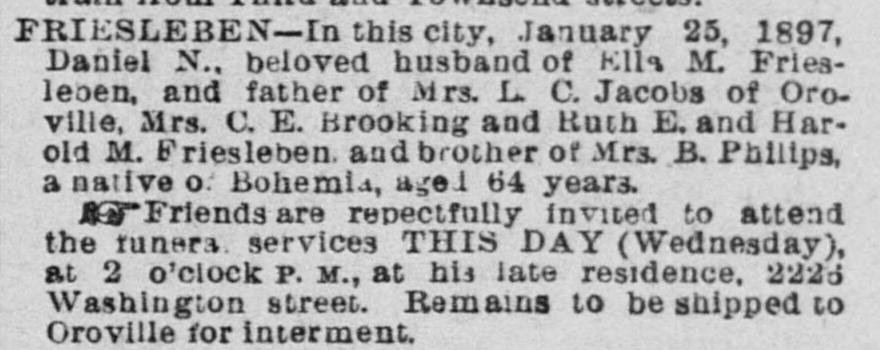
Daniel later married Ella M. Friesleben. When he died on 25 January 1897 at sixty-four, his death notice named Ella and four children (Mrs. L. C. Jacobs of Oroville, Mrs. C. E. Brooking, Ruth E. Freisleben, and Harold M. Freisleben) and also named his sister, Mrs. B. Phillips.
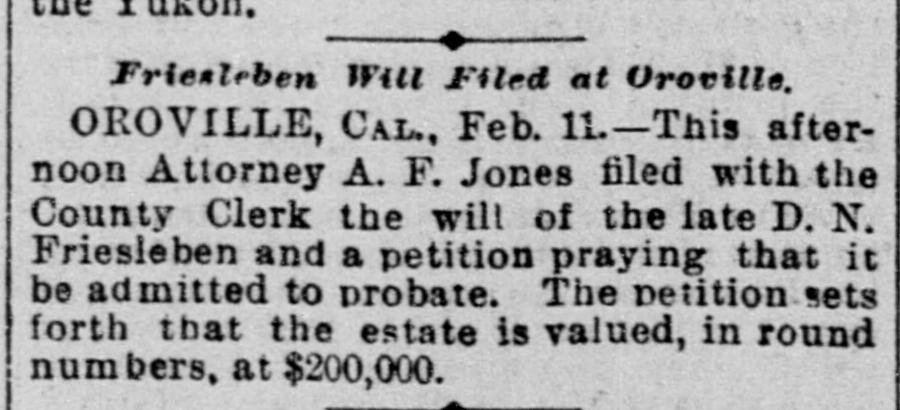
His body was sent back to Oroville for burial. A contemporary dispatch says his will and a probate petition were filed with the Butte County clerk on 11 February 1897, and that the petition valued the estate at about $200,000, a large merchant’s fortune and enough to fit George West’s memory of the wealthy son who paid for the wall. The county probate index lists the case as Frielesben, Daniel Nathan, Superior Court case 994; the printed misspelling is the index’s own.
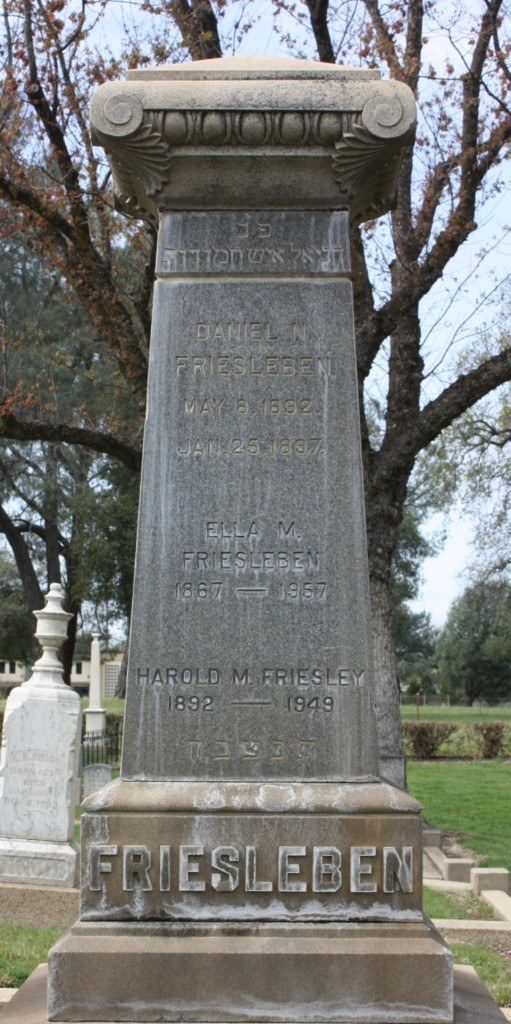
Daniel lies in the Oroville Jewish cemetery near Rosa, Lena, and the three children who died young. A tall monument carries FRIESLEBEN across its base and gives his birth as 8 May 1832, matching the Purschau birth entry from house no. 8. It also names Ella M. Friesleben, 1867 to 1957, and Harold M. Friesley, 1892 to 1949, whom Daniel’s death notice identifies as his wife and his son. His Hebrew inscription calls him a man greatly beloved. Nearby, a marker placed by Congregation Beth Israel of Chico tells how Oroville’s Jewish cemetery was established in 1859, received its deed in 1871, and became the resting place of the region’s early Jewish families.
Back at the wall
Daniel was Nathan’s son and Jakob’s grandson, the third generation of the family tied to houses no. 8 and no. 1 in Purschau. His 8 May 1832 birth record names Nathan as his father and Jakob as his grandfather, and his later fortune in California identifies him as the wealthy son George West described. According to West’s account, Daniel commissioned the wall around his father’s grave.
One question remains: was anyone else buried with Nathan? The 1844 report confirms that a Freisleben child died in the nearby woods, Rosa’s grave is in Oroville, and the child’s burial place remains unknown.
The enclosure still stands on land owned by a utility company near Lebanon Lake, not part of a maintained cemetery. Jews still come there to daven. Inside, Nathan’s slab names Purschau and his father, Yaakov the Levite.
Until 1937
Nathan left a living kehillah behind. Jakob had stayed at house no. 1 until his death in 1846, and in the decades that followed Freislebens still appear in the same Purschau property books.
In the 1860s the annotations name Moritz, Johann or Johanna, Anna, and Lazar Freisleben; a 12 July 1865 entry records a provision in favor of Lazar. Another layer from 1860 names Josefa Strecker, née Freisleben, a daughter of the village who married out but kept her birth name in the record. In 1871 a later registration identifies Salomon Freisleben as seller and Hermann, also written Neftali, Freisleben as purchaser, and Adelheid Freisleben, Salomon’s daughter, received a life or residential right in the same transaction. The books keep writing Freisleben onto house shares and Wohnungsrechte long after the Lumberland branch had crossed the ocean.
At the beginning of the 1860s, Schön counted fourteen Jewish families in Purschau, ninety-five souls, then the young people went to the towns. The 1900 census still found seventeen Jews among 735 villagers. In 1919 the kehillah sold the shul, damaged by fire fifteen years earlier, to a private buyer. In 1937 the last Jewish family left for Tachov, and a later Purschau note names the merchant Julius Löwy as the last Jew in the village. Between Jakob at house no. 1 and that final departure ran more than a century of Freisleben life in Purschau, fathers to sons, daughters with Wohnrecht, and names still entered in the ground book long after Nathan’s stone stood by Lebanon Lake.
Timeline
- 1783
- Jacob Nathan is recorded in Tachau with a wife and two children, trading in ribbons and knives.
- 1793
- Jacob Freyßleben is recorded in Purschau with his wife Sara and two daughters. A clerk rendered the daughters’ names in abbreviated forms resembling “Ja” and “Rößl.”
- 1811
- A house-no.-1 property entry records a capital obligation of 200 gulden in favor of Jakob Freisleben.
- 24 July 1819
- The Purschau familiant record names Nathan as Jakob Freyßleben’s eldest son and transfers Jakob’s legal family place to him under gubernial decree no. 33038. The same record associates Jakob Freyßleben with the earlier name Jakob Nathan.
- 25 February 1822
- Juda Jacob Freisleben senior executes a contract selling Purschau property no. 8 to Nathan Freisleben junior for 300 gulden. The contract is presented on 19 August 1822 and entered on ground-book folio 72.
- 1827
- Filipina Freisleben, recorded as Jakob’s daughter, dies in Purschau at about twenty-five.
- 8 May 1832
- A Purschau birth entry records Daniel in house no. 8, son of Nathan and Barbara.
- August 1834
- A Purschau birth entry still names Nathan, son of Jakob, as the acting father.
- 28, 29 June 1842
- Nathan Freisleben sells the emphyteutic dwelling at Purschau conscription no. 8 to Andreas and Anna Stahl for 200 gulden Convention currency. The deed ties his title to ground-book folio 72. Rosa signs a related filing as his wife.
- 20 December 1842
- The Amtsblatt zur Prager Zeitung shows that Rosa had already left: a Tachau court names her among the heirs of her mother, Barbara Steinhart of Uschau, whereabouts unknown.
- 9 July 1843
- Jakob Freisleben executes a contract selling property to David Schwager. A registration dated 13 March 1850 describes the property as half of the emphyteutic dwelling at conscription no. 1.
- 1844
- A young Friesleben child disappears in Forestburgh and is found dead in the snow on the tenth day.
- 2 October 1846
- Juda/Jakob Freisleben dies in Purschau, still recorded as a ninety-year-old merchant of house no. 1.
- 1850
- A Lumberland census sheet records N., R., and 18-year-old D. Frislabend in one household. The enumerator wrote Nathan’s age as 75. Leopold’s household also appears.
- 22 December 1851
- Nathan Freisleben dies, age 59, and is buried near Lebanon Lake.
- March 1853
- A Tachau-district absentee list names Daniel Freisleben of Purschau, born 1832, and Andreas Freisleben of Purschau, born 1829.
- 1856
- A Tachau recruitment-fugitive declaration names Hermann Freisleben of Purschau and gives his birth year as 1834.
- January 1857
- An Austrian military edict orders Daniel Freisleben of Purschau, born 1832, to return from America within six months. The same edict names Hermann Freisleben of Purschau, born 1829.
- 1860s
- Purschau property annotations name Moritz, Johann or Johanna, Anna, and Lazar Freisleben; a 12 July 1865 entry favors Lazar; another 1860 layer names Josefa Strecker, née Freisleben. Schön counts fourteen Jewish families totaling ninety-five souls.
- 1871
- A Purschau property registration names Salomon Freisleben as seller and Hermann, also written Neftali, Freisleben as purchaser; Adelheid Freisleben, Salomon’s daughter, receives a life or residential right.
- 16 February 1862
- Nelson, then the only son of D. N. Friesleben, dies in Oroville at two months and twelve days.
- 1863
- An Oroville directory lists D. N. Friesleben under dry goods.
- 1866
- A directory places D. N. Friesleben’s dry-goods and clothing business on Montgomery Street. The Union Hotel is listed separately under W. L. Hopkins.
- 1867
- Eda Freisleben dies at one month and is buried in the family plot.
- 1868
- Rosa dies at Oroville, aged sixty-eight. Her grave names her mother of D. N. Freisleben.
- 1869
- Louis, son of D. N. and L. Freisleben, dies at six.
- 1881
- A Butte County directory lists D. N. Friesleben as proprietor of the Union Hotel, with 1,520 acres.
- 1889
- Daniel’s wife Lena dies at fifty and is buried in the family plot at Oroville.
- 1894
- A Monticello paper identifies Nathan’s grave and attributes the wall to an unnamed wealthy son in the West.
- 1897
- Daniel dies with an estate petition valued at about $200,000. His death notice names wife Ella, four children, and a sister. The Butte County probate index lists him as Daniel Nathan, case 994.
- 1900
- The Purschau census counts seventeen Jews among 735 villagers.
- 1903
- The Hancock Herald and other local papers run the grave as a mystery. A later account connects it to an old rabbi and a child lost in the woods.
- 1919
- The Purschau kehillah sells the shul to a private buyer.
- 1937
- The last Jewish family leaves Purschau for Tachov. A later local note names the merchant Julius Löwy as the last Jew in the village.
- Today
- The enclosure still stands near Lebanon Lake. Jews still come to daven there.
Sources
- 3D scan of the grave and its enclosure: View As-Built virtual tour. The cover photograph shows the same enclosure.
- Republican Watchman (Monticello), “Lebanon Lake Park. Nathan Frisleben,” c. 27 July 1894: Fulton History (PDF).
- 1903 “Lonely Grave” and Fiesland story: Hancock Herald, 30 April 1903, on NYS Historic Newspapers; also the Republican Watchman, Port Jervis Tri-States Union, Sullivan County Record, and Middletown Daily Press, May 1903.
- Forestburgh child, 1844: Republican Watchman, 20 March 1844, on NYS Historic Newspapers; James Eldridge Quinlan, History of Sullivan County (1873).
- Daniel N. Friesleben will and estate: San Francisco Call, 12 February 1897, page 4, on the Library of Congress. His death notice, 27 January 1897, names wife Ella M.; children Mrs. L. C. Jacobs, Mrs. C. E. Brooking, Ruth E., and Harold M.; and sister Mrs. B. Phillips. Rosa Friesleben death notice: Weekly Butte Record (Oroville), 1 August 1868. Nelson Friesleben death notice: Weekly Butte Record, 22 February 1862, page 2, on the Library of Congress: “Nelson, only son of D. N. Friesleben, aged two months and 12 days.” Butte County probate index: Butte County Probate Records, 1850, 1917, Chico State Special Collections, PDF page 39, “0994s, Frielesben, Daniel Nathan,” on the Chico State PDF.
- Oroville Jewish Cemetery burials: tombstone transcription by Karen Peltier, 20 May 2004, on Interment.net: Rosa (“Mother of D. N. Freisleben,” d. 23 July 1868, aged 68), Daniel N. (8 May 1832, 25 January 1897), Lena (d. 23 December 1889), Nelson, Louis, Eda, Ella M., and Harold M. Friesley, “In Freisleben plot.” The monument photograph shows Daniel N., Ella M., and Harold M. Friesley on one stone, Hebrew above and below. Cemetery history: Oroville Cemetery District (established 1859; deeded 11 April 1871; first recorded burial 16 February 1862); historical marker by Congregation Beth Israel of Chico, on HMDB; California Office of Historic Preservation, resource P585.
- Oroville store photograph, c. 1880: Northeastern California Historical Photograph Collection, Meriam Library, CSU Chico (sc21323), original print 115×165 mm, Pioneer Museum, Oroville; scan on CSU Chico Digital Collections and Calisphere. 1863 Oroville dry-goods listing: Hand-book Almanac for the Pacific States, printed page 138, Wikimedia Commons PDF. 1866 Montgomery Street listing: George Owens, A General Directory and Business Guide of the Principal Towns in the Upper Country (San Francisco, 1866), printed page 65*, Library of Congress copy on the Internet Archive; the same page lists the Union Hotel under W. L. Hopkins. 1881 Union Hotel listing: Butte County Directory for the Year 1881, printed page 374, CSU Chico Digital Collections, coll41:8024.
- Isaac and Roosa Friesleben mortgage (10 June 1851, Halfway Brook; to John A. Thompson, assigned to Ulysses Brewster; Sullivan County Mortgage Book 14): mortgage-sale notice in the Republican Watchman (Monticello), run 21 June, 12 July, 19 July and 9 August 1854, on NYS Historic Newspapers.
- Leopold Friesleben death notice: Chicago Tribune, 10 February 1879 (Find A Grave memorial photo of the printed notice). Household: 1870 U.S. Census, Chicago Ward 20. Leopold’s arrival: passenger list of the Stephanie, 26 July 1842 (Immigrant Ships Transcribers Guild). Map: F. W. Beers, County Atlas of Sullivan, New York (1875).
- 1850 U.S. Census, Lumberland, Sullivan County, N.Y., NARA M432, roll 603: dwelling and family 7/7, enumerated 16 July 1850. The enumerator wrote N. Frislabend, age 75, farmer, $150 real estate, born Germany; R., age 50; and D., age 18, farmer, born Germany (Ancestry, image 4215526_00007). Leopold’s household appears on the same cluster of Frislabend entries.
- Elizabeth (Friesleben) Florsheim: WikiTree (married Simon Florsheim, Chicago, 1861; died 7 February 1933; Rosehill Cemetery).
- Purschau Jewish family book (HBF 115), folio 121: Jakob Freisleben, once written Jakob Nathan; Nathan named as his first son, receiving Jakob’s legal family place on 24 July 1819. Via Zayt. Published Pilsen familiant control list, p. 31: Nathan admitted to his father’s family position laut Gubernialdekret 24. Juli 1819 Zahl 33038, PDF.
- Jewish census of the Plzeň circle: 1783, Tachau town, Jacob Nathan, married, ribbons and knives, PDF; 1793, Dorf Purschau, Jacob Freyßleben, wife Sara, and two daughters, PDF. Charles University, Prague.
- Purschau (Pořejov) Jewish registers, deaths (HBMa inv. 1643, via Zayt): Jakob Freisleben, merchant, 2 October 1846, house no. 1, aged ninety; Filipina Freisleben, daughter of Jakob, 9 February 1827, aged about twenty-five.
- Purschau (Pořejov) Jewish registers, births (HBMa inv. 1641, via Zayt): Daniel, 8 May 1832, house no. 8, father Nathan son of Jakob, mother Barbara; August 1834, Nathan son of Jakob named as the acting father. A later 1850 Freisleben birth names Mayer/Majer Freisleben and Johanna Wollner as the parents and does not show that Nathan was still living in Purschau.
- Purschau land books (SOA Plzeň, fond Velkostatek Tachov), Emphyteutisches Grundbuch des Dorfes Purschau Nro. 8 (k0429; multi-house volume): 1811 house-no.-1 capital obligation of 200 gulden in favor of Jakob Freisleben; folio 72 contract of 25 February 1822 (presented 19 August 1822), Juda Jacob Freisleben senior to Nathan Freisleben junior, property no. 8, 300 gulden; 9 July 1843 Jakob Freisleben sale to David Schwager, with 13 March 1850 registration describing half of the emphyteutic dwelling at conscription no. 1; 1860s annotations naming Moritz, Johann/Johanna, Anna, and Lazar Freisleben, a 12 July 1865 provision for Lazar, and Josefa Strecker née Freisleben; 1871 registration of Salomon Freisleben (seller) to Hermann/Neftali Freisleben (purchaser), with Adelheid Freisleben’s residential right. Grundbuch der Gemeinde Purschau Nro 19: k0428. Rusticalgrundbuch für das Dorf Purschau Nro 35: k0430.
- 1842 sale of the emphyteutic dwelling at Purschau conscription no. 8: SOA Plzeň, Velkostatek Tachov, Pränotations-Urkunden- und Ehecontracten-Buch (from November 1841), k0475, folio 171. Contract dated 28 June 1842, presented 29 June 1842: Nathan Freisleben to Andreas and Anna Stahl, 200 gulden Convention currency; title clause ties Nathan’s ownership to ground book lit. F, no. 8, folio 72; Rosa (Rosalia) Freisleben signs as Nathan’s wife. Andreas signed; Anna used three crosses.
- Tachau court notice for the estate of Barbara Steinhart of Uschau no. 34: Amtsblatt zur Prager Zeitung, 20 December 1842, page 4 (notice dated Tachau, 25 November 1842). Names Rosa Freisleben among the heirs, whereabouts unknown. Other records identify Barbara as Rosa’s mother. National Library of the Czech Republic, Kramerius, uuid:d6a90ce1-eb3f-4fe4-8204-9325de57b514: viewer; page image.
- 1838 cadastral map of Purschau (Pořejov): house no. 1 is the old manor in the village center; house no. 8 is the next cluster. The black numbers on the buildings are the same house numbers later census sheets use. Scan as published on Purschau / Pořejov, Golden Road vanished villages. Manor, synagogue wing, and remaining pond: Pořejov castle. Census house lists, same numbering: Porta fontium, 1869, 1880, 1921.
- Village size in 1838: 104 houses, 734 inhabitants, fourteen Jewish families in four houses. Johann Gottfried Sommer, Das Königreich Böhmen, vol. 6 (Pilsner Kreis), Prague, 1838; also the Purschau village memory page, Příběhy Sudet.
- Amtsblatt zur Prager Zeitung precursor draft notices: March 1853 Tachau-district absentee list naming Daniel Freisleben of Purschau, born 1832, and Andreas Freisleben of Purschau, born 1829, Kramerius uuid:914444b3-…. 1856 Tachau recruitment-fugitive declaration naming Hermann Freisleben of Purschau, birth year given as 1834, Kramerius uuid:08cf84c5-….
- Wiener Zeitung, 22 January 1857, page 24: Einberufungs-Edikt of the k. k. Kreisamt Eger, 3 January 1857, naming Daniel Freisleben of Purschau, born 1832, and Hermann Freisleben of Purschau, born 1829, among men of the Tachau district in America who were ordered home. ANNO, Austrian National Library: page 24.
- Josef Schön, “Geschichte der Juden in Tachau und Umgebung,” in Hugo Gold, ed., Die Juden und Judengemeinden Böhmens in Vergangenheit und Gegenwart (Brünn, 1934), Purschau on printed p. 641: by the beginning of the 1860s, fourteen Jewish families totaling 95 people; emigration beginning in the 1860s and 1870s. PDF.
- Alfred Freisleben (1930, 2013), Erinnerung an Daheim, typescript at the Tachauer Heimatmuseum, Weiden; biographical note on Kohoutí kříž, including that the Jewish Freislebens of Purschau left for the United States, and that in 1937 the merchant Julius Löwy remained as the last Jew in the village. Last Jewish family leaving Purschau for Tachov in 1937: Radek Procyk, Židovské hřbitovy na Tachovsku (Charles University bachelor’s thesis, 2008), citing F. Schuster, Tachau-Pfraumberger Heimat, p. 22, PDF. 1900 census, 17 Jews among 735 inhabitants, synagogue fire 1904 and sale 1919: Czech Wikipedia, Pořejov.
- Pořejov (Purschau) community: Cimiterium cemetery database; Jewish monuments of Bohemia, Moravia and Silesia (synagogue from 1765; the Levitical share of the stones); Czech Wikipedia; Pořejov Jewish cemetery.