Rosh Hashanah Filming Scandal
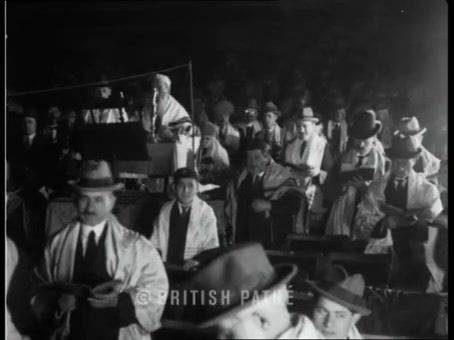
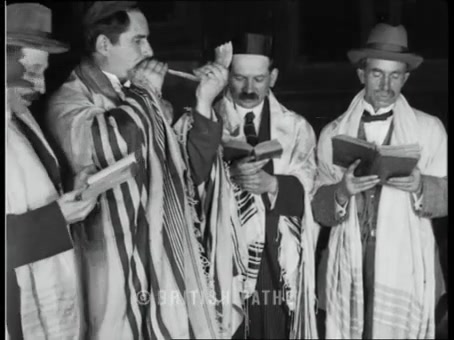
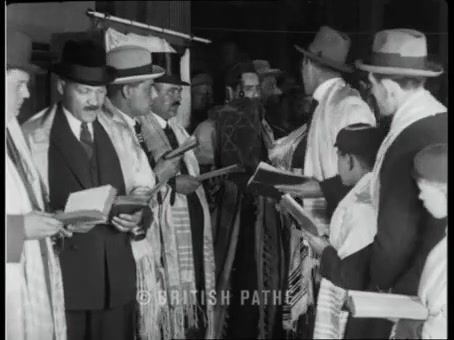
On Rosh Hashanah 1922, Pathé filmed packed East End davening in a Mile End cinema: men in talleisim, machzorim open, a baal tokeia sounding the shofar.
British Pathé, “JEWISH NEW YEAR” (1922; asset 49674; Film ID 284.11; canister G 915; Media URN 23269). Silent newsreel, about 64 seconds. Pathé issued the item on 28 September 1922.
Pathé in the Palladium
Rosh Hashanah, East End, September 1922. Inside a packed cinema hall, men sit in hats and white talleisim with machzorim open, a bimah in the middle, and someone holding a Torah with a Magen David on the mantle, while a Pathé newsreel crew is already rolling. Near the end of the reel a baal tokeia sounds the shofar while three men follow in their books.
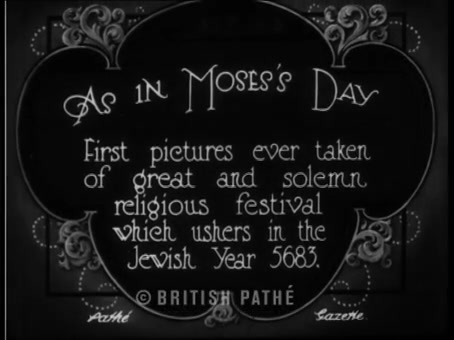
Pathé sold it as a scoop. The title card says: “AS IN MOSES’S DAY. First pictures ever taken of great and solemn religious festival which ushers in the Jewish Year 5683.” Within days the same pictures were playing in cinemas and music halls.
A cinema for the Yamim Noraim
That packed hall was overflow. The kehillah was the Bow, Bromley & Mile End Synagogue and Talmud Torah, at 56 Bow Road, and for the Yamim Noraim (High Holidays) their own building could not hold the crowd, so they davened in the Mile End Palladium, a cinema at 370 Mile End Road. East End shuls often rented picture houses for Rosh Hashanah and Yom Kippur when the shul could not hold the davening.
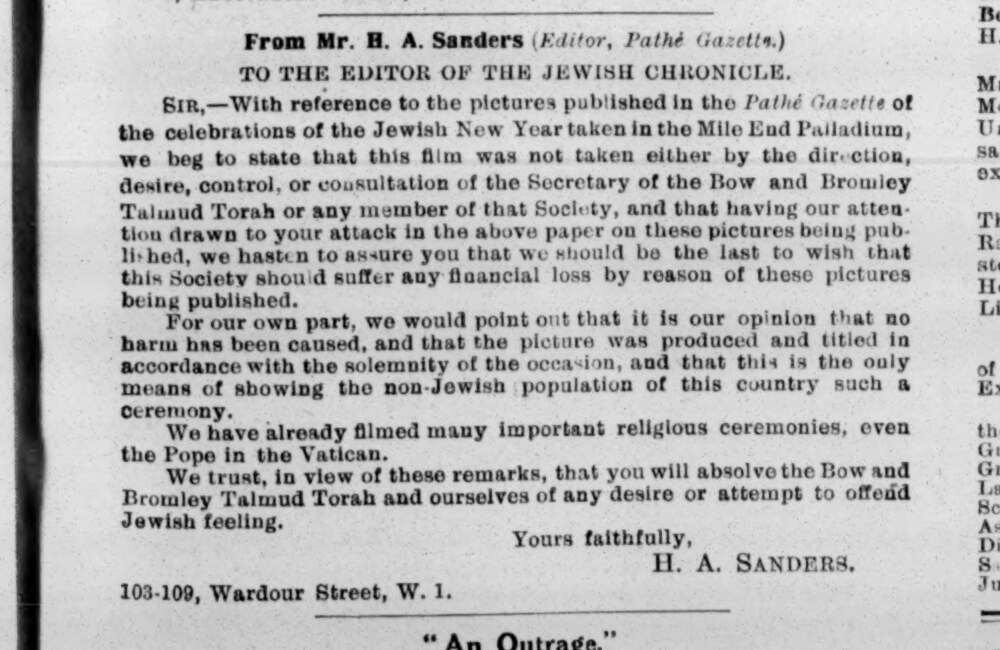
Pathé’s catalog never printed that hall. It only says London. The Palladium name comes from Pathé itself: on 13 October, H. A. Sanders, editor of the Pathé Gazette (cinema newsreel), wrote that the New Year pictures were “taken in the Mile End Palladium.”
The date is in the frames. Rosh Hashanah 5683 began on Shabbos, 23 September, when the shofar is not sounded, and the film shows a shofar. That puts the camera on Sunday, 24 September, the second day, four days before Pathé released the reel.
Mile End Palladium (cinema / Yamim Noraim overflow hall)
370 Mile End Road, Mile End, London E3
51.52454, -0.03629
Map pin near 370 Mile End Road. The Palladium opened in 1914, closed in 1938, took bomb damage in the war, and was demolished. Housing stands there now.
“Desecrating the Holy Days”
Pathé issued the item on Thursday, 28 September. Less than two weeks later, on 6 October, London’s Jewish weekly the Jewish Chronicle (pp. 5, 6) made the filming the centerpiece of a broader attack on Yamim Noraim publicity:
“At the Bow and Bromley Talmud Torah on Rosh Hashanah, for instance, a film was taken while the service was in progress. The picture was subsequently on view at the variety halls.”
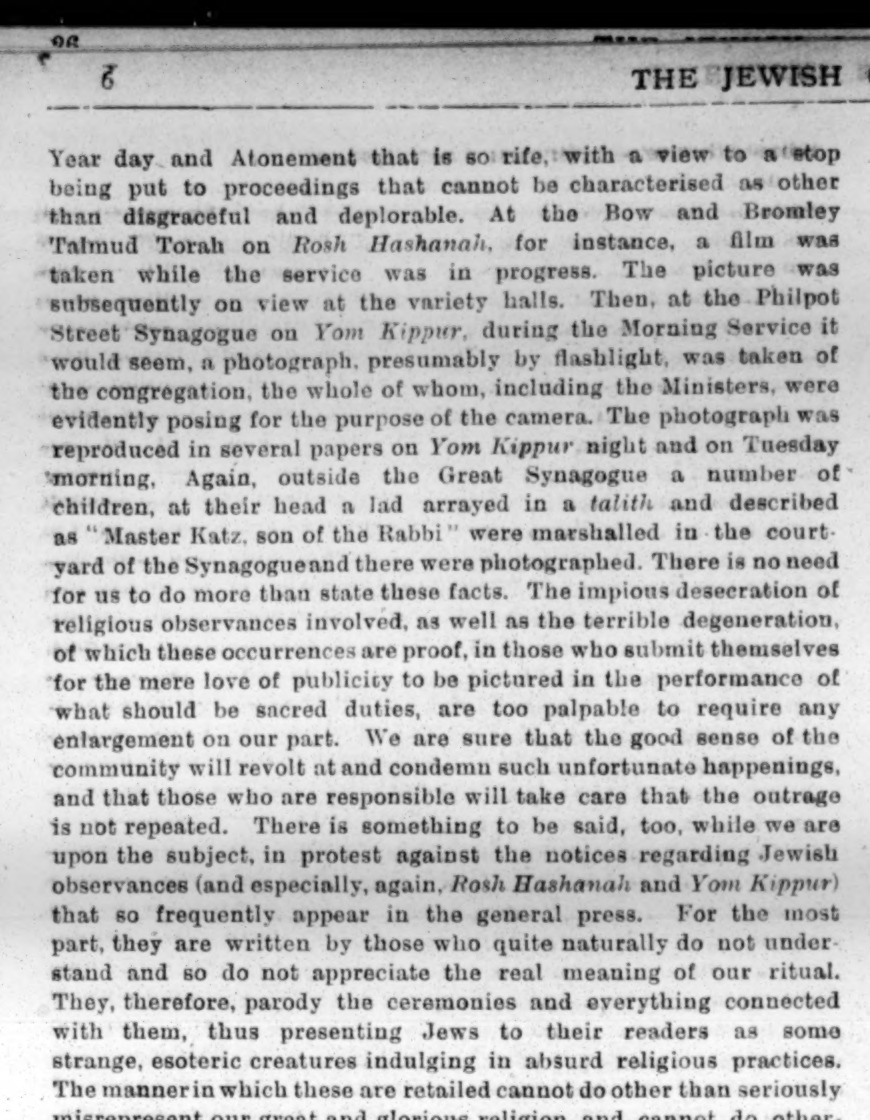
The same editorial also hit flashlight photographs at Philpot Street Synagogue and outside the Great Synagogue on Yom Kippur. It called the publicity “impious desecration,” and said communal good sense ought to stop a repeat.
Who let the cameras in
A week later, on 13 October, the Jewish Chronicle (p. 21) filled a page with replies. The fight on the ground was over who had allowed the cameras.
H. Liebert, secretary of Bow, Bromley and Mile End Synagogue and Talmud Torah, said the film was taken in “one of our halls,” not in the shul itself. The committee, he wrote, “beg to disown any responsibility.” The deal, they had learned, was between Pathé Gazette and the Gentile hall manager, without the committee’s knowledge or consent.
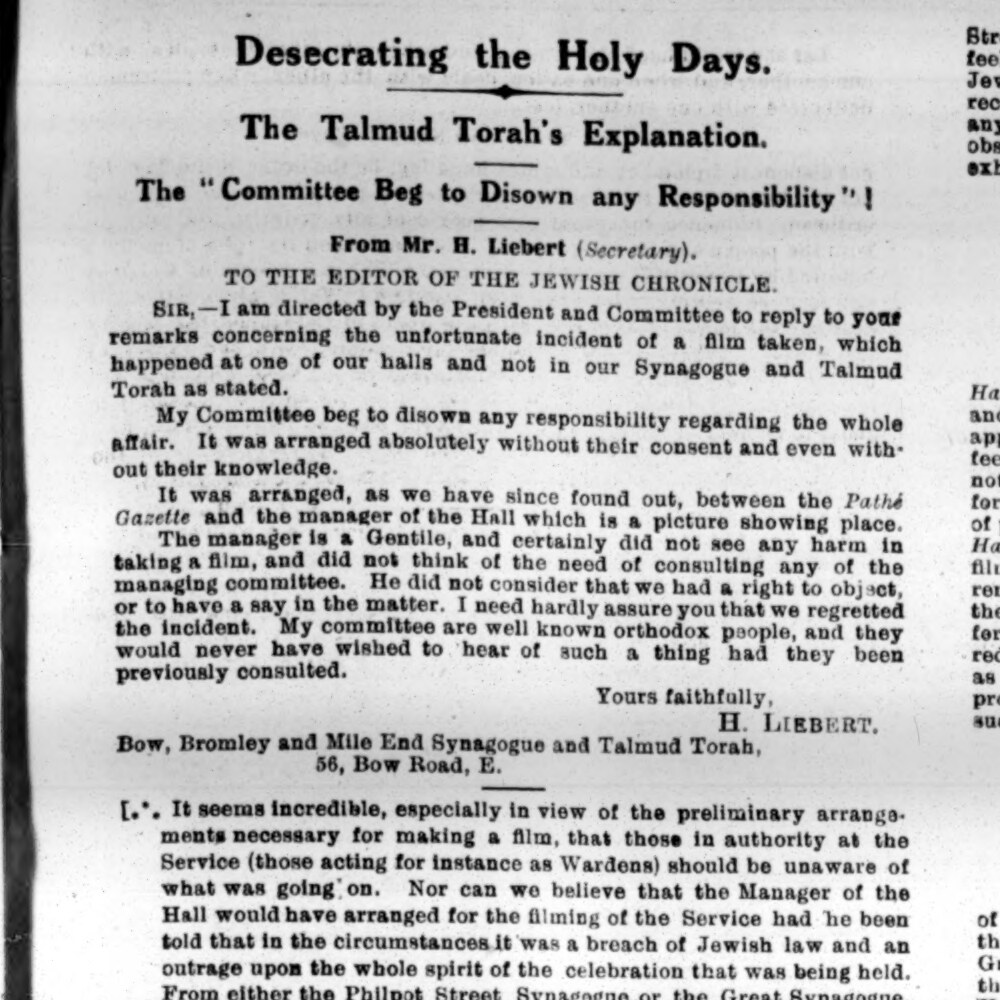
The editor was not buying it. In a note under the letter he called it “incredible” that the wardens could have missed a camera crew, and wrote that filming was “a breach of Jewish law and an outrage upon the whole spirit of the celebration.”
Sanders answered for Pathé. The society had not directed or approved the shoot, he said. The pictures had been titled with “the solemnity of the occasion.” Showing the davening to non-Jews was the point. Pathé had already filmed other religious ceremonies, “even the Pope in the Vatican.”
Other letters that week stayed angry. One correspondent who saw the reel in a Kent picture-house said parts of the audience laughed. An East End note said Orthodox circles were angry, that even less Orthodox people disliked the novelty, and that a London Yiddish daily had protested too, stopping just short of calling it a chillul Hashem. Philip Hyams added that London’s Jewish weekly Jewish World had covered the affair as well.
The film and what followed
Pathé Gazette issued “Jewish New Year” on 28 September 1922. Within two weeks the Jewish Chronicle had condemned the shoot, named the Mile End Palladium, and printed the kehillah’s denial. The reel itself stayed in Pathé’s archive.
JCR-UK notes the Bow, Bromley & Mile End kehillah closed, possibly in the 1920s. The Palladium Cinema closed in 1938, later took bomb damage, and was demolished.
Timeline
- April 1914
- Mile End Palladium opens as a cinema at 370 Mile End Road.
- c. 1919
- Bow, Bromley & Mile End Synagogue and Talmud Torah at 56 Bow Road; Talmud Torah about 245 pupils.
- 23 Sept 1922 / 1 Tishrei 5683
- First day of Rosh Hashanah falls on Shabbos; no shofar.
- 24 Sept 1922 / 2 Tishrei 5683
- Second day of Rosh Hashanah; Pathé films the Palladium davening, including tekias shofar.
- 28 Sept 1922
- Pathé Gazette issues “Jewish New Year” (canister G 915; Film ID 284.11).
- 6 Oct 1922
- Jewish Chronicle (pp. 5, 6) editorial “Desecrating the Holy Days” condemns the Bow and Bromley Rosh Hashanah film.
- 13 Oct 1922
- Jewish Chronicle (p. 21) prints Liebert’s denial, Pathé’s Sanders letter naming the Mile End Palladium, and further protest letters.
- 1920s
- JCR-UK notes the Bow, Bromley & Mile End kehillah closed, possibly in this decade.
- 3 Apr 1938
- Palladium Cinema closes; later bomb-damaged and demolished.